In short
- Disconnect affected machines from the network without switching them off, and keep the ransom note.
- Report to Report Fraud, formerly Action Fraud (England, Wales and Northern Ireland) or Police Scotland, and tell the ICO within 72 hours if personal data is involved.
- Before thinking about paying, check backups, snapshots, known decryptors and what a lab can recover.
The first hour
- Isolate: unplug network cables and turn off Wi-Fi on the affected machines and the NAS. Leave them powered on if you can, as memory can hold evidence and sometimes keys.
- Protect the backups: disconnect backup drives and check that the backup server or cloud account has not been reached. Change the passwords of backup and admin accounts from a clean device.
- Keep the evidence: photograph the ransom note, note the file extension added to your files, the time you noticed and anything unusual in the days before.
- Do not delete encrypted files, reinstall systems or run cleaning tools yet. Encrypted files are what a decryptor or a recovery will work on.
Who to tell in the UK
- Report Fraud (the national service that replaced Action Fraud) takes reports of cybercrime in England, Wales and Northern Ireland: report online through Report Fraud's reporting guide. Businesses and charities under attack right now should call 0300 123 2040 immediately.
- In Scotland, call Police Scotland on 101.
- The National Cyber Security Centre publishes guidance for organisations and individuals, and handles significant incidents.
- If personal data was or may have been affected, organisations must assess the risk and, where required, report the breach to the ICO within 72 hours of becoming aware of it, as set out in the UK GDPR.
- Tell your cyber insurer before acting, if you have one: many policies set conditions on incident response.
Should you pay?
The NCSC and the police advise against paying. Payment does not guarantee a working decryptor, many victims are attacked again, and the data is often published anyway. Payments to sanctioned groups can also be illegal. Look at every other option first.
What can be recovered without paying
- Backups and snapshots: offline copies, NAS snapshots and cloud version history are often untouched. Check them before restoring anything.
- Free decryptors: the No More Ransom project, backed by Europol and police forces including the UK's, offers decryptors for many families. Identify the strain first.
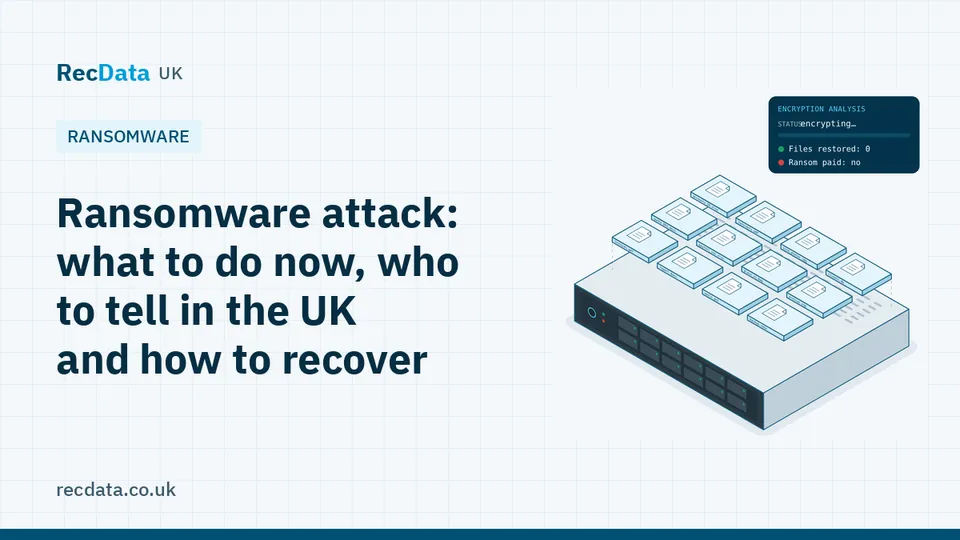
- Lab recovery: many strains encrypt only the first part of large files, skip some files, or delete the originals in a way that leaves them recoverable from the disk. Virtual machine disks, databases and NAS volumes often contain intact data that can be extracted.
Preventing the next one
Follow the NCSC guidance on mitigating malware and ransomware: keep at least one backup offline, apply updates promptly, use multi-factor authentication on remote access and email, and never expose a NAS directly to the internet. The UK government's Cyber Essentials scheme is a practical starting point for small organisations.
Our lab work on encrypted systems is described on ransomware data recovery, with specific pages for server data recovery and NAS data recovery.
Frequently asked questions
Is a ransomware attack a personal data breach under the UK GDPR?
Often, yes. Losing access to personal data, even temporarily, is a breach, and many attacks also copy data out. The organisation must assess the risk and report to the ICO within 72 hours where it is likely to affect people's rights.
Can you recover files encrypted by ransomware?
Sometimes, without the key. It depends on the strain and on how it worked on your system. We analyse a sample of encrypted files and the disks free of charge and tell you what is realistic before any work.
Should I switch the infected computer off?
Disconnect it from the network but leave it running if you can, unless it is still encrypting files you can see changing. Then shut it down. A clean shutdown is better than pulling the plug on a server.
Official sources and useful links
- National Cyber Security Centre (NCSC): The UK's technical authority for cyber security: incident reporting and guidance for organisations and individuals.
- Report Fraud (formerly Action Fraud): The UK's national reporting centre for fraud and cybercrime (England, Wales and Northern Ireland).
- Police Scotland: In Scotland, cybercrime is reported to Police Scotland on 101.
- Information Commissioner's Office (ICO): The UK data protection regulator: personal data breach reporting and UK GDPR guidance.
- No More Ransom: Free decryption tools for some ransomware families, from Europol and police forces including the UK's.
Is your data important?
Do not try anything that could make the fault worse. The diagnosis is free and you get a fixed quote before any work starts.